Tuesday, December 1, 2015

Chinese basic


All characters contain a particular component called "radical" or "side". These elements were once characters themselves, but some are no longer recognizable as such. Learning the radicals helps to categorize and memorize characters; the presence of a certain radical can even suggest the meaning of the whole character, which often relates to the original form of the radical. On the other hand, the non-radical component of the character often suggests its pronounciation, or viceversa.
Chinese dictionaries contain more than 200 radicals, but you will easily memorize the most common ones. In the following lessons we'll present 60 radicals, each of them followed by three characters that contain them, by compounds and notes on their use.
Please note that the shape of a radical changes according to its position in the character, and that the same radical could well be found at the top of a character and on the left side of another: our examples couldn't always show all of the possibilities. As for the pinyin transcription, we didn't put the tones (pronounciation doesn't really concern us by now) nor the umlauts that certain syllables have.

#1 The first radical is called the "two drops of water"; it usually appears in characters that have to do with coldness. It's placed at the left side of characters.

#2 This radical always stays on top of characters.

#3 This radical is called "speech", and it appears at the left side of characters that have to do with language.

#4 The original form of the "knife" is also a radical; it's found at the bottom of characters, as in the first of the following. The second character shows a third form of this radical (placed on top):

fento divide
zhengto argue

#5 The fifth radical is called the "standing person", and is always placed at the left side of characters. The character it comes from can also be used as a radical; in that case it always stays on top, as in the following character:

zhongcrowd

#6 The first radical is called the "ear", and it can stay at the left side or at the right side of characters.

#7 This radical is called "three drops of water", symbolizes flowing water and occurs on the left of characters. Its original form is also a radical; in the following character is placed at the bottom but its position is not fixed:

quanspring, fountain

#8 The original form of the "heart" is also radical, and is always placed at the bottom, as in the following character:

sithought

#10 This radical is called "the covering top" and it always occurs on top. Characters with this radical are often related to the idea of house.

#12 The original form of this radical is also a radical, as in the following character:
chaoto exceed


#13 The original form of the "soil" is also radical, and is always placed at the bottom, as in the following characters:
chendust
zuoto sit
#16 The original form of the"hand" is also a radical, placed at the bottom or on the left:
nato hold, to take
baito worship, to respect

#17 The "mouth" is not always placed on the left of characters, as in the following examples:
mingname
shihistory
#19 This radical also stays on top or at the bottom of characters:
suiyear
yuehigh mountain
#23 The original form of the "dog" is also a radical, as in the following character:
kuto cry
#24 This radical can also be found at the bottom of characters:
qiwife
#25 The "son" is not always placed on the left of characters, as in the following example:
xiaofilial piety
#26 The "horse" is also found at the bottom of characters, as in the following:
mato curse
#28 The original form of the "fire" is also a radical, placed on the left of characters, as in the following examples:
denglamp
yansmoke
#29 This radical also stays at the bottom of characters:
pangside

#31 The original form of this radical is also a radical, found at the bottom of characters:

jinto forbid

#33 The "tree" also stays on top or at the bottom of characters, as in the following examples:

liplum
zhuotable

#35 This radical is not always found on the left side of characters:

xingstar
chunspring


Monday, October 5, 2015

The 24 Paragons of Filial Piety

How true that the Chinese treat their elderly better than in the west? Well, from my limited experience they do, particularly if the older person is a member of their family or a friend or aquaintance.

I think this may stem from a long held tradition which Confucius promoted. 
He  said: “In serving his parents, a filial son reveres them in daily life; he makes them happy while he nourishes them; he takes anxious care of them in sickness; he shows great sorrow over their death; and he sacrifices to them with solemnity.”

When Buddhism was introduced to China, it had to be redefined to support filial piety, because Buddhism in India involved many men leaving or abandoning their families, parents, wives, and children to become monks (Buddha himself was said to have done so). The true Buddhist had to reject all family ties.
Other societies and religions have similar tenents –  in Judaism and Christianity, one of the Ten Commandments is ‘honour your father and mother’ but these days this is more practiced in the breach rather than the observance.
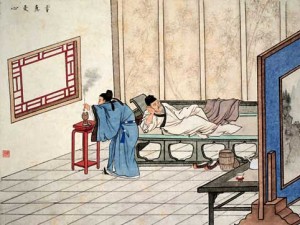
About 600 years ago, during the Yuan Dynasty (AD 1271-1368 ), a Chinese scholar called Guo Jujing combed through folk histories in search of true stories of the finest examples of filial respect, as practiced by devoted children throughout the centuries. He selected twenty-four tales, and penned a verse to eulogize each authentic account of filial practice and accompanied each verse with the uplifting story of the events that lead to each son or daughter’s examplary conduct.
The book that resulted from his work was calledThe Twenty-four Paragons of Filial Devotion;as its title suggests, it provides 24 examples of adult children demonstrating their love and respect for their parents in an exemplary manner.

The tales are extraordinary – charming, frightning, dark, sad and horrid by turns – think  Charles Perrault   meets the Brothers Grimm.
Here is the full list  of fables that Guo Jujing compiled:
1. Filial Conduct That Impressed The Gods: Shun The Great
2. Personally Checking His Mother’s Prescriptions:The Learned Emperor Of Han
3. His Heart Was Pained When His Mother Bit Her Finger: Zeng Shen
4. Clad In A Threadbare Jacket, He Tolerated His Cruel Stepmother: Min Ziqian
5. Carrying Loads Of Rice On His Back To Feed His Parents: Zi Lu

6. Entering Servitude To Pay For His Father’s Funeral: Dong Yong
7. Bringing Deers’ Milk To His Ailing Parents: Young Master Tan
8. Taking On Menial Labor To Support His Mother:Jiang Ge
9. Stealing Oranges To Take Home For His Mother: Lu Ji
10. Never Tiring Of Feeding Milk To Her Mother-In-Law: Lady Tang
11. Attracting Mosquitos To Drink His Blood: Wu Meng

12. Lying Down On The Ice To Get Carp For His Stepmother: Wang Xiang
13. Burying His Son To Save His Mother: Guo Ju
14. Wrestling With A Tiger To Save His Father: Yang Xiang
15. Resigning Office To Search For His Mother: Zhu Shouchang
16. Deeply Concerned, He Tasted His Father’s Stool:Yu Qianlou

17. Costumes And Pranks To Amuse His Parents: Lao Laizi
18. Picking Mulberries For His Mother: Cai Shun
19. He Fanned The Pillow And Warmed the Sheets: Huang Xiang
20. A Bubbling Spring And Leaping Carp: Jiang Shi
21. Crying By The Grave When Thunder Rolled: Wang Weiyuan
22. Serving Wooden Statues Of His Parents: Ding Lan
23. Tears That Brought Bamboo Shoots From The Frozen Earth: Meng Zong
24. Personally Scrubbing His Mother’s Chamber Pot:Huang Tingjian
To give you an example, here is the story of number 12:
Wang Xiang lived in the Western Jin Dynasty (AD 265-316). His mother died when he was young. His stepmother didn’t treat him well and often spoke ill of him in front of his father. Because of this, he also lost the love of his father. But when his parents were ill, he took care of them carefully. One cold winter day, his stepmother wanted to eat fresh fish. He took off his clothes and lay on the frozen river to melt the ice with his body. The ice melted and two carp leaped out. He took them home and his stepmother was moved.
The verse written to honour Wang goes:
Stepmothers abound on this earth
But rare are sons like Lucky Wang
Even now when the river freezes over
We recall his icy sacrifice for Mother

Friday, September 18, 2015

Singapore F1. 18~20 Sep

PIT GRANDSTAND

Situated right opposite the team garages, Pit Grandstand ticketholders are in an excellent position to catch the adrenaline-pumping action on the Pit Straight and enjoy great views of the Pit Lane, starting grid and finish line.

Petrolheads will experience the thrill first-hand as drivers tackle the final corner at about 200 km/h before going full throttle towards the chequered flag. Join in the celebrations on the track after the race and witness the crowning of a champion.

The Pit Straight was also the setting for AUTOSPORT Award's 'LG Moment of the Year' in 2010, where Heikki Kovalainen's Lotus burst into flames in the final leg of the race, prompting him to extinguish the fire himself.

Patrons have access to Zone 1Zone 2Zone 3 and Zone 4.


TURN 3 PREMIER GRANDSTAND

Located at the end of the first set of turns, the Turn 3 Premier Grandstand offers views of the cars compete for overtaking opportunities at Sheares (Turn 1) before braking to 90km/h as they tackle Turn 3, pick up speed and go full throttle down Republic Boulevard. Spectators will also be able to see the Formula One™ cars rejoin the action on the track as they exit the Pit Lane at Turn 2.

The Turn 3 Premier Grandstand offers an upgraded experience for those who want to be close to the action while enjoying more exclusivity and convenience. Each ticket includes 2 meal vouchers, 2 snack vouchers and 5 drink vouchers per day (beer, wine or soft drinks), which can be redeemed at the premium food and beverage facilities adjacent to the grandstand, or at the dedicated bars. Patrons will also receive an amenity pack daily, with quality earplugs, poncho and other amenities. To top it off, patrons will enjoy wider cushioned seats and have exclusive access to executive restroom facilities.

Patrons have access to Zones 1, 23 and 4.


LOUNGE @ TURN 3

The Lounge @ Turn 3 invites guests to unwind in an all-new hospitality offering by Singapore GP. Strategically located just a stone’s throw from the Circuit Park’s second largest entertainment zone, the Village Stage and the F1 Village, the lounge offers guests the perfect environment to take a respite from the hustle and bustle of the day’s activities.

Here, guests can relax and enjoy free flow of wines, beers and soft drinks in air-conditioned comfort between races or follow every second of the track activities via live television screening indoors. To get even closer to the race action, head outdoors to the Turn 3 Premier Grandstand just behind where guests can witness the adrenaline pumping action along the first three corners of the Marina Bay Street Circuit. All guests will get assigned seating with wider and cushioned seats at the Turn 3 Premier Grandstand.

Patrons have access to Zones 1, 23 and 4.


3-DAY GRANDSTANDS

TURN 2 GRANDSTAND

With a superior vantage view of the first three turns of the track and of the cars exiting the Pit Lane, this is where skilled manoeuvring will keep fans on the edge of their seats. Turn 2 Grandstand patrons get a great view of the oncoming cars as they approach Sheares (Turn 1) from 290km/h. The cars will then negotiate Turn 2 before slowing down to 90km/h at Turn 3. 

In 2012, fans here witnessed Felipe Massa’s Ferrari sustain a puncture in the first lap, following a collision with Vitaly Petrov’s Caterham. Turn 2 is also where Mark Webber's Red Bull hit the barriers in 2009 due to a right front brake failure, ending his race prematurely.

Patrons have access to Zone 1Zone 2Zone 3 and Zone 4.

PRICING DETAILS
$888

SUNDAY ZONE 1 SPECIAL

SUNDAY PIT GRANDSTAND

This is a single-day ticket for petrolheads who are gunning for the adrenaline-pumping race action on the Pit Straight.  Situated right opposite the team garages, Pit Grandstand ticketholders will enjoy great views of the Pit Lane, starting grid and finish line. 

Experience the thrill first-hand as drivers tackle the final corner at about 200 km/h before going full throttle towards the chequered flag. You will be able to witness the crowning of a  champion and join in the celebrations on the track after the race.

The Pit Straight was the setting for AUTOSPORT Award’s ‘Moment of the Year’ in 2010, where Heikki Kovalainen’s Lotus burst into flames in the final leg of the race, prompting him to extinguish the fire himself.

Patrons have access to Zone 1Zone 2Zone 3 andZone 4.

Friday, July 24, 2015

Japanese cheesecake


INGREDIENTS:

3 eggs
120 g white chocolate (you can also use dark chocolate as healthier alternative)
120g unsalted cream cheese (room temperature)

PREPARATION:

Separate the whites and yolks. Leave the egg white in the fridge and put the oven on 170 degrees. Melt the white chocolate on the steam. After cooling, put the cream cheese. Then add the yolks and mix with spatula. Take out the whites from the fridge and whisk until you get good snow.

Mix with a plastic spatula the cream cheese and chocolate with the egg snow. (see video)

Put some oil in the baking pan with 15 cm diameter and pour the mixture. Lift it and dropt it for several times to remove all the air. Take care not to brake the cake during baking.

Put in large pan some hot water and place the pan with the mixture in it. Bake 15 minutes at 170 degrees, than 15 minutes at 160 degrees. After that turn off the oven and let the cake rest for another 15 minutes in it.

Take it out of the oven, and leave it to cool completely. Sprinkle the powdered sugar on it.

Video : http://youtu.be/dVvPOE-C7AE

Relax is my fave past time

Relax is my fave past time
Sabah

Making up in progress

Making up in progress

Feeling cold, nice feeling

Feeling cold, nice feeling

The expert

The expert

Dressing up Maiko

Dressing up Maiko
In Tokyo

More on dressing up Kimono

More on dressing up Kimono
Tokyo Harajuku

Almost ready

Almost ready

Voila!

Voila!

Final touch up b4 shooting

Final touch up b4 shooting

Here, my dream of taking kimono came so true! Yippie!!!

Here, my dream of taking kimono came so true! Yippie!!!

Charlie Angels! C'est mon ami.

Charlie Angels! C'est mon ami.

One of my fave shot

One of my fave shot

More ...another fave shot

More ...another fave shot

VAIN shot

VAIN shot

Ready...Say Cheese!

Ready...Say Cheese!

Smile...makes the whole world smile

Smile...makes the whole world smile

2gether, god friendz frm Tokyo!

2gether, god friendz frm Tokyo!

Akiko n i

Akiko n i

Oui, C'est moi!

Oui, C'est moi!

À bientot

À bientot

My Fave Omu Rice

My Fave Omu Rice
In Tokyo

My best pal in Sin Lay Lay

My best pal in Sin Lay Lay
Holland V

In KL

Lay's place @ Holland V

Lay's place @ Holland V

With photographer

With photographer
Harajuku